We Support Grand Jury Resisters; or, What’s that Banner in the Window All About?

by W

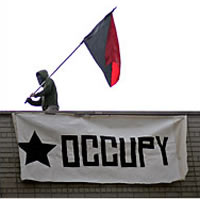
Anarchists, activists and many others have long been plagued by the power of the courts as they reinforce the status quo under the banner of justice.  The secretive Grand Jury proceedings have been a draconian tool used to carry out out secretive questionings without allowing council, and often with a suspension of the ultimately empty right to remain silent.  All this can amount to witch hunts, especially concerning those investigating anarchists in the Pacific Northwest and New York City, most recently.

It can be difficult to pinpoint the goals of such punitive proceedings, as it is rarely stated outright what they are investigating, nor when they began, but someone who refuses to answer questions can be held in civil contempt for the entirety of the investigation (up to 18 months, barring extension).  And so in the midst of such proceedings in the Pacific Northwest last year, presumably in connection with the May Day riot in Seattle (that actually followed its establishment), several anarchists were brought in for questioning and then imprisoned due to their belief that the authority of the state is illegitimate and (therefore) should not be cooperated with.  In solidarity with those particular folks we made and hung the banner in our window, also recognizing similar actions by other infoshops across the country.  I was particularly fond of The Holdout’s sign that stated, “No one talks, everyone walks.”

Some folks in the Northwest avoided the subpoena or refused to attend regardless of being served, commendably.  And while one anarchist who had avoided the serve was still being notably harassed by law enforcement as recently as September, everyone was released from prison there.  Still, that investigation has received a six month extension to March 4th, 2014, and is thus an ongoing problem.  The most recent manifestation of such repression has left one of our own in prison in New York City, however.

For the second time Jerry Koch was brought in to a grand jury inquisition regarding the bombing of a military recruitment station in Times Square, and in again refusing to testify he now finds himself in prison.  Recently motions have been made to release Jerry from confinement as it was meant to be coercive and he clearly has no intention of cooperating with the state.  For all of his strength, though, he can still use support.  As such, we continue to run our banner and put free materials out about his case and how to contact him and his support committee.

Such materials can be found at jerryresists[dot]net.

For further reading, New York Year Zero has also put out zine format materials on Jerry and the Pacific Northwest Grand Jury Resisters, and nopoliticalrepression[dot]wordpress[dot]com has occasional updates on the situation out west, too.  Mind you, these are not isolated incidents, and animal rights and environmental activists have suffered the great brunt of such proceedings in the enveloping Green Scare of the the last decade, or so, as was well documented by Will Potter.  The first Earth Liberation Front Press Office, consisting of Leslie James Pickering and Craig Rosebraugh in the 90’s, also documented similar experiences in book form (meanwhile, Pickering is still having his communications monitored at his residence in Buffalo, NY).  And to round out the recent occurrences, there was also the case of solidarity of anarchists with the Latin Kings in North Carolina, who were undergoing grand jury proceedings there, documentation of which was published in zine form by negate city.

allThingsRevolt

ByLusinstrella

When I first discovered the Wooden Shoe I was pregnant -though nobody could really tell – Philly was covered in snow and I was taking a few days break, after having been on the road for a month. I had embarked on a discovery trip from New Orleans to New York, through the major cities of the East Coast. I had seen Nashville and Memphis, Chattanooga and Washington.

The Shoe was still on 5th street and I stumbled upon it, while roaming through what I thought was the first livable place in the USA. I was wearing a pair of military boots that proved inadequate to protect me from the bitter cold and I had on, in a multitude of layers, basically all the clothes I had brought with me from my beloved and warm Tuscan countryside.

I remember the clear recognizable sensation of entering a male militant place.

The dark stuffy room crowded with books was nonetheless exactly what I needed at that particular moment in my life, coming from the artificial neat emptiness of the southern suburbs, with its white wooden porches, where afternoon were spent talking about inconsistent, harmless idiocies and thinking of the next delivered meal and cheap canned beer.

My growing belly, relentless curiosity and undeniable impulsiveness, together with a remarkable series of cultural, political and mostly linguistic misunderstandings created such an unlikely and unforeseen circumstance that I had ended up spending the entire fall and some of that winter in Louisiana, on the outskirts of New Orleans.

It could be the memory of my morning sickness, but I still get nauseous when something reminds me of those strange days. The whistle of a freight train slowly passing through the city. A series of identical and well tended front yards disseminated with mini-American-flags, bird feeders/baths and other trivial signs of melancholic obsessiveness. The smell of those vicious artificial house perfumes that plug into electrical sockets and have the most improbable names – spring rain, mountain breeze, laundry drying in the sunshine – so ineffective at covering up the stale smell of cigarettes, old couches, liquors and endless sad nights spent in front of giant TV screens, trying very hard not to talk, to mask frustration, anger, passion and depression under a well spread coating of properness.

Mostly it’s that sensation of total estrangement and surreality, the inauthentic formalities, the wide and alien smiles that still makes my head spin today and made me, on occasion, bang it on the wall back then. My road trip was an escape attempt really from that privileged kingdom of plastic futilities and unhealthy food imposed on me as the banner of the American life style.

Upon entering finally, that day in January, the dusty room where the old wooden shoe was, I felt I could finally breathe. I knew exactly what to do, how to move. It was a familiar place, with familiar people and it made me feel at home, in those days of excruciating nostalgia for all that I have always loved and always ended up leaving behind .

I remember buying a wicca book of herbs and a whole lot of subversive t-shirts to send back home, mostly as a physical, undeniable proof of the existence of such a place in the very center of the American empire. I was so excited about my find, an anarchist bookstore in full view, with sign and everything, in the middle of an American metropolis, that I could hardly contain myself!

It was 2004 and we were in the middle of a war me and all the people I cared for had opposed with all our impotency and all our desperate determination. Bush, the most hated and yet most precise icon of capitalism, was president.

My friends and dear comrades back in Italy almost stopped talking to me when they heard of my intentions of moving to the States. They also considered the fact that I was having a baby with a Yankee, more or less, an act of high treason. They didn’t shave my head though and paraded me naked through the streets. The style had changed since the days of partisans and resourceful women, selling themselves indiscriminately to Nazis and Allies. Indiscrimination being at the core of their crime, since while it was somehow accepted to give an American soldier a blowjob in exchange for a bar of chocolate, it was unfathomable to lay with a German one in order to survive. It didn’t even matter if they both had unimaginable – for us – blue eyes.

My baby’s father had unimaginable blue eyes and I was, not even secretly, hoping he would pass them on, together with his status and his seemingly safe, easy life. He didn’t, and if I happen to think about it, I still feel a sharp sadness for all that wasted blue.

Some of my closest friends went so far, in order to protect me from the consequences of my unforgivable distraction, as to let me know that, if I ever should change my mind about the identity of the father… well…they were there for me!

I had not been convincing evidently, not at all, with my argument that the only place where it would be worth the risk of starting a revolution was indeed North America, because until we could reclaim that territory, there was not a chance of us being able to accomplish anything in Europe. Not without provoking a military intervention on their part, and seeing our beautiful cities torn asunder by their bombs once again.

Truth was that somehow, and for reasons not entirely clear even to myself, I had really wanted all this. I wanted a child, I wanted security and I wanted to get away. From many things, broken promises, disappointments and heartbreaks, but especially from the failure of a long struggle that had been my life from the age of 13 and that seemed to have met its definitive Death on the streets of Genoa. The wounds were still so fresh. Silence had fallen upon us and would not leave. America was just any place for me, good enough because distant enough. So, with a determination not unlike that of my II world war ancestors, I had jumped on the first available horse, together with a prince I didn’t really care for, but who cared for me enough to take me somewhere else. A practice, that, not all like me and, in the political context I was living in, profoundly incorrect but, just like those women in the war, I was ready to fake, grind my teeth and even live in a sort of suspension from my political beliefs, until I reached what I thought was safety for me and my baby.

What I thought was safety, but was only security. The security, for my recalcitrant self, of a well closed coffin. As Harry Miller had predicted in Sexus, I had cut off my legs and acquired a prothesis, so I wouldn’t feel the pain of my real flesh.

The first time I staffed at the Wooden Shoe, years later, with an impossibly big an active toddler at my side – living proof that northerners’ genes are a whole lot to handle on us Mediterranean people- I brought with me some incense to light, because, in my opinion, the store bore a mark too big of a male made place. Not that incense is, necessarily, an object charged with femaleness, but at least it made the place smell better.

Through the Wooden Shoe I met a lot of people, and was able to find out and eventually connect with most of the other anarchist spaces in the city. Without it, it would have been way more difficult for me to continue with this kind of political activism so far away from home.

Today my level of involvement is almost scary for somebody like me, who brought home from the school of Autonomia an inherent refusal to belong to any kind of political organization. Autonomi or Loose Dogs, that’s what we used to call ourselves, to indicate the fact that our political actions were to be considered always independent and never bore the trademark of parties or movements of any sort, even though they might at times and peripherally, support them. It was, of course, a resistance to bureaucracy and to structures, always more or less hierarchical, more or less sclerotized. In the Italian context it was also the only way to relate somewhat sanely to the communist party and its minutious and centralized organization. Actually, to the Anarchists Federation and the Tute Bianche as well, all falling, even in the way they occupy space, in the same pathetic mimicry of the worst bureaucratic structure, with the same people sitting at the same place on the podium at every meeting and with no real turn over in the central roles.

If you asked me why I stayed this time around, I would tell you that I don’t want the store to close down. That for me, as cheesy as it might sound, the world feels a little less depressing, as long as a place like this can go on existing. Maybe I somewhat changed and the wooden shoe changed too, both as a physical space and as a collective. We don’t live anymore in the dark room of 5th st and have rented a purpled walls, breathable, wide space, with old granny style armchairs and a kids books section. It is even somewhat clean.

As a political experience, this is much more than simply a book store and you wouldn’t believe the incredible amount of work and dedication necessary to make it work, the energy and passion that is concentrated in this project.

How can it stay open then, what are the political practices that allowed it to survive for now more than 35 years?

Well, the main thing is, the way I see it, that the Wooden Shoe could be run, in almost all its aspects by almost any of us collective members or staffers.

Of course, sharing knowledge is what we should always do to keep at bay that instinct to fascism that Deleuze and Guattari talked so much about to describe our imprinted desire to be leaders and/or to follow leaders. And it works too. In fact, even though antianity in the collective can confer a special aura, in a place where everybody has access to the knowledge around it, that power remains on a mere abstract level.

I have being hanging out in radical spaces for pretty much half my life and always found some sort of charismatic or strategic leader, usually a man, who had a lot to say about the appropriateness of political practices and the correct radicalism index of random ideas. Of course I never liked it by instinct, but only now I realize with clarity that it’s not just about me being definitely not a follower by inclination, but also about the reification of acquired practices, the opposition to a power structure and a bureaucratic organization that makes change more difficult.

I can stay in this collective because I feel it changing, continuously changing, because I feel that I and anybody else involved has the power to change it. I’m not trying to say that we do not have a long road ahead of us and a lot of work to do to try and dismantle some of the oppressive power dynamics we all grew up in, but I know that everybody there is willing to do the work, willing to be confronted and willing to learn new ways.

Sharing knowledge, finally, is not only more sustainable in the long run, it also makes it more difficult for us to simply die out, either because of some external form of oppression or from internal lack of energy. In other words, we are all easily replaceable, just in case we decide to move on, end up in jail for some or other direct action or somebody decides that one of us should be shot dead while sleeping. Of course we do not do, as a collective, anything dangerous to the point of deserving such special attention, but I still bear the marks of Genoa and the clear memory of the funeral we had to chant for our struggle. Now with the NDAA gloomily hovering over our horizon, and this general atmosphere of brutal repression, it would be worth opening a dialogue about effective resistance strategies, so that whatever they’ll decide to do to any of us, it will be really hard to crack down the movement this time around.

Accounting for the Cause

By Jini Kades

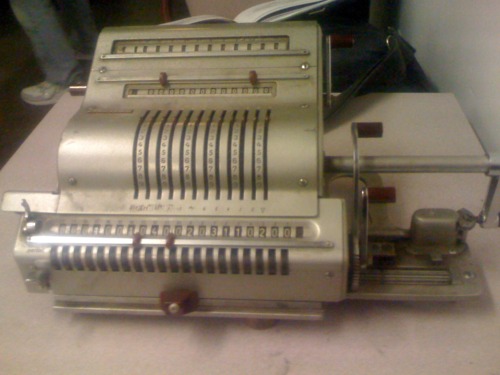
Coffee in one hand, calculator in the other, I try and gain focus, staring at the rows and columns of numbers glowing out at me from the QuickBooks screen. I swivel in my chair as I copy and paste formatted cells into Excel. Though eerily similar to what I might find myself doing Monday – Friday at my cubicle out in the burbs, it’s a Sunday afternoon and I’m behind the counter at – you guessed it – everyone’s favorite Philly-based anarchist bookstore collective. I’m surrounded by the rudimentaries of the trade: old riot folk flyers-turned-scrap-paper, an old yogurt container full of free Mazzoni Center condoms, and vegan-gluten-free-fair-trade-organic chocolate bars. Maneuvering around the web of wires draped across the floor connecting the decades-old collection tangle of phone, computer, and music equipment, I perform the glorious monthly task bestowed upon me by the Wooden Shoe collective: pay and record the store’s sales tax.

How radical do I feel at this moment, as I sign over an ACH deposit to the PA Department of Revenue? Not very. But that’s OK. I’ll make up for it by throwing in my two cents later at the weekly meeting, perhaps in a discussion of how to best support friends and staffers jailed during direct actions, whether we should sell an interesting book by an author with questionable ethics, or how to best approach conflict mediation amongst our own members. These questions are debated as we strive to uphold the consensus process and our principles of anti-racism, anti-sexism, and so forth. But this is all after I give a budget reportback. And after someone on the Tech committee reports on a new Info Shop Keeper (ISK) interface we can use to streamline our inventory system. Then, perhaps after a spirit-lifting/blood-boiling, yet intellectually stimulating political debate, we might argue the finer points of selling gift certificates this holiday season.

When I started staffing at the Shoe about two years ago, a year after moving to Philadelphia, I was stoked to be a part of a new community that seemed tight-knit and plugged into the outside Philly world in a way I’d been yearning for. In exchange for volunteering a few hours a week, or just a couple times a month, I had the chance to make new friends and be among the first to know about concerts and speaking events, and be at the forefront of local political movements!

When I decided after a few months that I wanted to stick with it in a real way and give back more time in exchange for stronger connections to the Wooden Shoe community, it was time to join a “committee,” the small groups that make decisions about different facets of the Shoe. There’s no vertical structure of management; instead, the Wooden Shoe forms small committees that take initiatives within their spheres. These committees bring any big decisions to the collective for horizontal, consensual decision-making. Did I want to be on the events committee? Find awesome speakers, musicians, poets, and authors, to share their talents at the Shoe? Maybe the book ordering committee, where I could spend my time reading up on the latest works published by contemporary thinkers in philosophy, politics, economics, and gender studies? Or maybe even the music ordering committee, where I could track down the latest albums by radical hip-hop, punk, or folk artists, and learn how to stock a store with these masterpieces?

While these options appealed to me, a plea from one of my sponsors (who ease your way into becoming a member of the collective) to join the then two-person finance committee, and to share whatever math skills I had gleaned from my very liberal-artsy economics degree, won me over. Has the budgeting and bill-paying and QuickBooks deciphering been exhilarating? Not so much. However, like much of the behind-the-scenes work at any successful venture, it’s a necessary evil, and I feel pretty great about my part in it. The now five-person, Super Magnanimous Finance Committee (new title bestowed, as of now, by my declaration), has all the Shoe’s fiscal tasks delegated among us. We are on top of our game. Though the process of divvying up those responsibilities has mutated many times over the years, it’s awe-inspiring to me that, 35 years later, the Wooden Shoe collective is still a financially stable, fully independent and consensus-based non-profit that continues to provide alternative media to the knowledge-hungry public (the 99%, if you will). Though not glamorous, what I do is an important part of the finance committee’s work, and just as essential as that of the menial tasks carried out by other committees. What amazes me most is how well it all comes together and that the collective efforts of the Shoe’s volunteers keep that neon sign glowing on South Street. (When we remember to turn it on, that is.)

Countless people have come and gone in the Shoe’s history, each making their own distinct mark, whether it was notably visible to the public or not. The Wooden Shoe is a testament to all the hard, under-the-radar work that people have put in over the years. Sure, people do boring shit all the time for a corporation or systemically entrenched organization, but how often does that work add up to something a person can proudly put their name to, where in between mundane tasks you can actually get your voice heard? In order to bring about materials and events that help inspire political, cultural, and social movements, everyone’s got to do the monotonous, everyday tasks once in a while. Sometimes that takes the shape of the paying the monthly sales tax. I’ll take it.

The Book of Love/Unlove

By Kristen Asher

There is a long history of rants and ranters at the Wooden Shoe. At some point, it became clear that neither the listserv nor the logbook were the right places for this type of business, and thus was born the Book of Love and the Book of Unlove: two of my very favorite pieces of Wooden Shoe literature. These books are a collective diary. They contain everything from crushes, love letters, and anonymous polls about in-store hook-ups (Book of Love material) to cynical diatribes on politics and the human condition and personal reflections about hating rainy days and bad breakups (more likely found in the Book of Unlove—follow?).

The Unlove notebooks that accumulated over the years contain some real gems:

“Cheap wine. I unlove you, you unravel me.”

“I unlove opening the store to discover smelly piss in the toilet from last night”

…both of which precede a THREE PAGE ENTRY that ends with:

“Our future leaders, idiots who drive nice cars, wear expensive clothing, live in huge houses, eat shitty food, watch massive amounts of television and specialize in a form of educated stupidity. Specialization is cultural autism, you’re incredibly fluent in your chosen field while surrounded by a world you have no idea how to properly comprehend.”

…There is a poll about what to name someone’s pet rat, lots of drawings including a whole page of (surprisingly recognizable) sketches of staffers, and an all caps entry that takes up almost a whole page that says “THE CALCULATOR HATES ME.”

…on Pac Man (which apparently is worthy of an entire page, including multiple drawings and this question as food for thought):

“where did the disagreement of Pacmen and ghosts begin and why do they feel the need to settle it in a maze?”

…on staffing alone:

“I unlove that there’s no one on swing shift, I’ve had 3 customers all day, no one bought anything, it’s rainy and I think my bike’s broken. Also, the computer won’t connect to the damn network so I can’t browse craigslist! Shoot me now!!”

…in response to something that had been written in the bathroom about taking showers with lovers:

“I f*cking HATE TAKING SHOWERS WITH OTHER People! Ok First Part I am 6’1” my lovas tend to be generally 5’4 to 5’8 usually due to close Body Proximity and general placement it usually means the shower nozzle is pointed DIRECTLY IN MY FACE!!!”

[this entry has a Part II and Part III and ends with “SHOWERS Suck!!!”]

The hands-on version of this is much better, in my opinion, and someone recently dug up many of the notebooks, which should be floating around behind the counter or downstairs. I highly recommend digging in…

So, at the very least these books are hilarious and pretty ridiculous, especially if you’ve ever been a staffer. If you’re more interested in idealizing things and giving the store some credit, (possibly more than it’s due, but let’s humor ourselves), these journals—and the act of having kept them—are a tribute to the humanness of everyone who has ever staffed here. They are an acknowledgment of the endless ups and downs that we face while sharing this physical and political space and that—no matter how far we fall short—the Wooden Shoe Collective at least attempts to create a place where this humanness is welcome. At the very least, the books are a source of collective memory, and that is an important thing to have in order to be able to grow while laughing at ourselves. Here’s to laughing at ourselves while being grounded enough to keep going and improving over 35 years, no matter what the Books say, and here is what I would write in these books, if I had to sum up my time so far:

I love that the age-old problem of filling shifts is no match for the age-old persistence, determination, and competence of both staffing coordinators AND staffers. Thirty-five years of last minute cancellations, frantic phone calls and emails, bouts of early closings and late openings means 35 years of people stepping up, supporting one another, donating heaps of time, filling the eternally dreadful role of staffing coordinator—experienced OR NOT—and maintaining enough hope, trust, and patience with one another to keep this place alive, not only as a store, but as a collective.

I love the struggle that we embody, sometimes as individuals, always as the entity that we compose collectively; the struggle between our thoughts and our actions; between our existence as humans with complex, fluid emotions and our presence in a world of machines with complicated, mechanized systems.

I love how we learn, everyday, to define and redefine ourselves:

How many times have you asked, been asked, or adamantly defended how a space can simultaneously espouse anarchism and participate in capitalism?

How many times have you read a contentious listserv conversation and 1) signed off while rolling your eyes; 2) responded furiously; or 3) constructed a thoughtful, long-winded, A+ composition, (of course, starting with an apology for the thoughtful, long-winded response you had just spent so much time writing with the intention to send it to the list), which inevitably resulted in at least 12 counterpoint emails, at least 3 emails about how we shouldn’t be using the listserv for such dialogue, and approximately 1-2 suggestions regarding other ways to have the conversation, including the possibility of creating another online forum—like a closed message board—where such discussions would be considered more appropriate?

How many times have you been disappointed with a decision, a process, or a person, but resolved to continue staffing, coming to meetings, finding ways to avoid or deal with the disappointment, and contributing to the ever-improving politics and dynamics of the Wooden Shoe? Some people don’t get the opportunity to find a friend or experience here who makes it worth the struggle. That is a serious issue. Others do. That is a serious reality.

How many times have you been held accountable or called on your shit? Did you use the wrong pronoun; make an offensive joke or comment? Did you take up too much space? Did you drop a project; disappear without warning; bail on a shift last minute? Did you tap your knee, squirm in your chair and sigh deeply while looking at the ceiling a couple too many times at the last 3 hour meeting?

But you’re here. We are here, together. There has been some form of “we” and “here together,” consistently, for 35 years. That means something.

* * *

The Books of Unlove are a lighthearted testament to the fact that there are lots of things to unlove about the Shoe. There are too many wires behind the counter, too many stepladders on the floor, an underuse of the vacuum cleaner in the basement, too many shoplifters and too few people filling shifts. Finding that “A” is over “D” or “D” is over “A” on the daily sheet at the end of the night ALWAYS SUCKS. Not being able to find a pen when someone is waiting to sign their credit card slip is annoying when, upon first glance behind the counter, you can easily locate 2 broken pencils, a stretched out rubberband, 10,000 fortune cookie fortunes, (all of which have written “in bed” at the end), a used up roll of tape and 5 paper clips. Once there was a copy of Wretched of the Earth in the Environment section. (.sigh.)

There are also a lot of real, deep, important issues that we have to confront as individuals and as a collective. But this is not new, either. If we want to continue to exist as a radical space with an anarchist, anti-oppressive philosophy and mission statement, we will always have room to grow.

There will always be 5 hour meetings (at least once in awhile). There will always be structures to create and then change as we learn the flaws we built into them. There will always be (hopefully decreasingly) difficult situations: conflicts between staffers, inappropriate jokes and comments, awkward conversations. It is a tall order, this stressful business of identifying for ourselves and to each other the sexism, racism, homophobia, transphobia, ageism, ableism, ignorance, and prejudice that we all bring to the table. It is ever-present, ever-important. It is the pulse.

And, so, here we are. Together. And that means something.

These challenges hold the Shoe to its potential and that is why I love it here. I am an anarchist because I believe in human empathy and in our ability to grasp concepts larger than ourselves, and then to not only have the competence, but the motivation to change ourselves through an understanding of those concepts. That means that I also believe in the potential for us to grow collectively; to destroy, create, and to change.

I love the Wooden Shoe because it is a space of potential.

People come here, make some friends, and move to another city.

People come here, read a few books, and join a different, much more radical collective.

People come here, settle in, and watch the collective body writhe and hear it groan; they move when it moves; they fill it and empty it; they open and close it.

And it hasn’t always been and won’t always be us. But i love that we are here, together, now. And that means something. Let’s make it mean something.

A place to be passionate

By Zen

“There’s an anarchist bookstore somewhere on South Street,” a friend or two of mine would tell me every once in awhile.  “It’s totally your kind of thing, you should check it out.”  Such a thing was EXACTLY what I was looking for, being out of work and college simultaneously.  My home life sucked, and my neighborhood bored me to depression and restlessness.  And so at some point
I made the decision to find this rumored bookstore, the Wooden Shoe by name.  It was one of the best decisions of my life, but at the time it was only that, a decision.

In fact, the Wooden Shoe Books & Records all-volunteer anarchist collective was not on South Street proper but, rather, a block north on 5th Street, caddy-corner to the 8 &12 store, so named for its hours which were intentionally one hour later in opening and closing than 7-11. This snarky bit of marketing always amused me for some reason, and served as a convenient point of reference.  The Shoe itself was tucked out of the way; its facade was mostly the same as the other stores along that block, its key distinguishing feature being the dreary black-and-grey paint job, which depicted something like masses of people but no real context.  The inside made much more sense, with a glass display full of punk and pro-biking patches, a cash register for the filthy lucre of capitalist transactions, and a front table full of books and periodicals whose theme changed with the month.  The place was small but found space for shelves of tomes about alternative education and covert US military endeavors, gay rights movement first-hand histories, and lovingly-made zines with instructions on how to make a ham radio or hack your cellphone or bake vegan cupcakes.  Old pamphlets written by industrial workers and their advocates-some stubbornly in print for over a hundred years-sat on a shelf in the back next to more recent commentaries about Palestinian resistance and animal liberation.

I don’t remember my first visit to the Shoe, I can only remember going back, over and over and over.  I could have simply handcuffed myself to the inside of the store somehow and died happy.  But I wanted to do more than that.  I was, I think, looking to prove myself-if only to myself.  I had emotionally broken down by the end of college and was arguably a drop-out; though that saved my sanity and thus qualifies as another great life decision.  So I eventually mustered up the courage to fill out an application, which went much better than prior experiences with for-profit employers.  They were ready to train me ASAP, and I was eager for the register experience.  Most people my age had some retail under their belt, but I was totally green.  The register itself was initially intimidating, as was the Shoe’s policy to insist on meticulous record keeping of transactions.  As a volunteer-based collective organization, the Shoe has to do its own financial accounting, and everyone has to do their part.  Much of my school woes were keeping up with the paperwork and multitasking, and in the beginning I felt those stressors like rising lava in my chest.  I was terrified of making people in the one place I felt safe resent me because of a fuckup I might commit or task I forgot to complete.  But the Shoe had a support structure of people, all of whom had been in my place before, to fall back on and ask for and *gasp* receive good advice and direct assistance when it was needed.

This, above all else, is what kept me going.  Everywhere else in my life, promises of emotional assurance possessed no more solidity than mist.  I learned through pain that bonds I thought I had were made of broken words when I fell into them.  And yet here, a group of strangers had created a place that backed you up when you needed it, and all that was asked in return is that you back them up when was their time to be in need.  They worked with you until you got it, earning your trust with action and not talk alone, and this connection was something I was aching for.

With time, patience, mistakes, forgiveness, and my personal committment, I began to smooth out the wrinkles in my ringups, remember the names of fellow staffers, make monthly meetings on time, and get out of my comfort zone. This culminated in the passing of my first proposal, which I made part way through my first year.  The proposal was for a first aid box, which we still have, full of gauze and over-the-counter pain meds for when biking staffers are bucked from their steeds and require some recuperation.  It came with us when we moved to our new location that really is on South Street proper, yards away from the corner of 7th St.  Our new locale reflects an enthused optimism, with bright clashing colors selected and applied my comrades and yours truly, while our old space was acquired by a bicycle repair collective who has helped me with brake pad troubles and wheel mishaps.  I like to think that when we left our old haunt, we planted seeds that bloomed in the hearts of those now teaching novice riders about spokes and calipers.

This coming August will count 7 years (WOW!) since I first started volunteering.  I have skill sets, friends, memories, books, buttons, photos of events and protests and comrades, and a sense of self-respect that I couldn’t get out of a 2-year art college or a dysfunctional family.  I feel more complete now.  For so long, I held myself back out of fear of wasting effort on those who would use me and throw me away.  The Wooden Shoe gave me a place to be passionate and selfless about, to work hard at and be proud of, to grow myself up.  I have the wisdom now to smile and use a gentle voice and words to help guide the newest volunteers, whose looks of brief panic and confusion mixed with an odd sense of hope are so familiar to me now, and yet so far away.

Overcoming Occupation

By Wode

When asked to participate or even attend another ‘Occupy’ meeting, I am all but reluctant in refusing.  The nature of this gathering—like so much of typical activism and the self-serving charity work it purports—if not the dreary discussions that come from the unmediated differentials of experience, are entirely tiresome to me.

Certainly this sort of thing is a learning process, as there is no set path to achieving social change, and I myself am learning more all the time.  Still, in my years involved in this sort of work, I’ve found that few things seem as effective as just creating, yourself, that which you want to see happen.

You may realize I am proposing direct action.  By direct action, I of course do not mean a committee within ‘Occupy’ that organizes submissive marches asking those profiting from the destruction of anything we may hold dear to change (no offense toward such committees doing what they can within Occupy, but therein lays the rub), but I do mean acting on what you purport to believe.  We all know politicians are liars and bureaucrats who muddle even the simplest of improvements, so why trust them?  We all know captains of industry only think in terms of money, so why believe that they’d accept anything that would limit their income (unless of course it improves their sales outlook, but I’m not looking to buy in).

Neither am I asking for some busted ‘Robin Hood’ tax.  I’m about taking away their means of operation and giving them nothing in return.  I’m not looking to compromise with government in order to maintain it, either—I seek the absolution of any hierarchy that requires I submit to them.  And just as importantly, I’m not trying to manipulate these proceedings in order to gain wealth or power (political or otherwise), because that would be perpetuating these same oppressions that I am seeking to destroy.

So how do we proceed?  To be honest (and effective for that matter), I’m not going to claim to have the answers nor be unwilling to adapt—however, I do have some suggestions.

The autonomous neighbourhoods of Greece seem to be a worthwhile standard to work toward, as a medium-term goal.  Essentially, that is creating whole neighbourhoods that refuse to allow police or other authority figures into them.  Whether they are squatted, purchased as land trusts, or some combination of these strategies (which could include reclaimed/occupied foreclosures and squats purchased from the city for a symbolic dollar), they are homes that shelter people.  And how do we ensure the growth of the neighborhood in a beneficial direction?  Certainly we have to talk to our neighbors, but the only way we can ensure commitment is to ensure we provide for people’s basic needs—because unless we’re doing that it’s nothing but talk.

If we can empower each other to take on feeding, clothing, housing, and defending ourselves, there is a greatly reduced desire to turn to the system for anything.  And by doing this within the city, we are still accessible to nearby neighbors who everyday gaze beyond the skyline in search of another way.  Remember how serious of a threat Nixon considered something as simple as the Black Panther’s free breakfast program.

As such, it’s still about so much more than providing an alternative, because even if we’re being effective the powerful dutifully realize that we must be quashed in order to maintain the status quo.  Rationally then, it is equally about building the alternative as much as it is about destroying the old system, because it is a threat to us.

With that in mind, we must be thoughtful in how we go about achieving these goals.

One of the helpful ideas I’ve gathered over the years is to try and collaborate with those you know and trust.  That’s fairly self-explanatory, I think.  Another, maybe less obvious concept, though, is to utilize those same kinds of channels that you know and trust.  For example, we are all aware that corporate media is likely to represent it’s own interests before our own, so it makes sense to employ independent media (if anything at all), unless we have the upper hand.  This gives rise to my next point—think and act tactically.  For instance, it would be inept to draw attention (media, or otherwise) to an effective action without being ready to fend off would-be-detractors.  Furthermore, it’s ineffective to pursue support for a cause amongst folks unaffected by it without empowering those who are affected to liberate or defend themselves.  Which brings me to my final point: openly celebrate only when you’re prepared to fully defend that which you’ve accomplished.  After all, drawing attention to that which you’ve done without the ability or desire to fight off the authorities is just inviting them to thwart you.  Ultimately, if you are effective in creating alternatives to the powerful system’s methods of operating they will come after you, or it will cost them.

The Shoe Collective

By James Generic
It’s difficult to work with a big group of people like our collective. We struggle, we disagree, and we fuck up. We also do some pretty amazing things, with the the fruits of our labor blossoming weeks, months, and years later. Faces change (and oh, do they ever change), but a lot of the faces and people, regardless whether they stay in this collective (which I hope they do), will maintain these bonds and links for years to come. What’s that saying? You can’t blow up a social relationship? This, if anything, is what will change the world. Trust, familiarity, and steadiness take years to build, as every revolutionary movement has shown.
There are a lot of people who don’t get it, and say we are the freaks of society for working in an unpaid environment and relying on self-motivation. It’s not easy, and not everyone can do it, which is fine as long as we acknowledge that the Wooden Shoe is a collective movement-oriented bookstore space, and that’s our role. We’re one moving cog of a larger anti-capitalist movement. An important one, in my opinion, in an important location that reaches a lot of people in Philadelphia, but just one moving part in a larger movement that wants to change the world. You need movement bookstores, preferably run by a collective.
We can see these opportunities in the recent Occupy movement. These spaces are places for social movements to grow, whether it be in shared experiences or running a collective. Last summer, for example, I helped put together a softball team, drawing heavily from shoe staffers and ex-shoe staffers I had met over the years. In reality, that’s what bonds us, these relationships and shared experiences, from the mundane shit work and small conversations, to the glory when it all seems to come together. So, don’t let anyone tell you any different: human nature is mutual aid.
Art by Albo Jeavons

A review of CrimethInc’s Work

by Wode

The poetic propaganda of crimethinc reaches for our hearts yet again in a burgeoning dialogue effectively aiming at a wider audience than previous works may have been able to reach.  Blossoming forth from this offering is the narrative’s ability to navigate the banal world of work without being overtly academic, or failing to relate to the common experience.  This book seems effective in dismissing most any defense of work that may manifest itself in the insipid hands of its defenders.  While this may seem like old hat to some, the vast majority of people who may have not considered all, if any, of these ideas will likely find something relevant to their own lives.

The only way this piece may have failed in its accessibility would likely be found in its length, which at 376 pages is not excessive, but neither is it something folks who don’t read are likely to pick up.  Still, there are a number of free posters and two pamphlet excerpts that can be printed for free from their website and distributed en masse.  Regardless of the medium chosen, the material is succinct, reasonable and accessible, making it a valuable tool in the ever-present discussions on economics.

If this does not once and for all ease the hapless critique of the anonymous, varied collective who’s moniker literally anyone can publish under, I’m not sure what else could.  Nevertheless, it is great to see such a thorough (and some might say, mature) analysis of our present situation that hasn’t sacrificed its passion one bit.

Art by Albo Jeavons

allThingsRevolt

By Lusinstrella

 When I first discovered the Wooden Shoe I was pregnant (though nobody could really tell), Philly was covered in snow, and I was taking a short break after having been on the road for a month. I had embarked on a discovery trip from New Orleans to New York, through the major cities of the East Coast. I had seen Nashville and Memphis, Chattanooga and Washington.

The Shoe was still on 5th street and I stumbled upon it while roaming through what I thought was the first livable place in the USA. I was wearing a pair of military boots that proved inadequate to protect me from the bitter cold and I had on, in a multitude of layers, basically all the clothes I had brought with me from my beloved and warm Tuscan countryside.

I remember the clearly recognizable sensation of entering a male militant place.

The dark stuffy room crowded with books was nonetheless exactly what I needed at that particular moment in my life, after coming from the artificial neat emptiness of the southern suburbs, with their white wooden porches, where afternoons were spent talking about inconsistent, harmless idiocies and thinking of the next delivered meal and cheap canned beer.

My growing belly, relentless curiosity, and undeniable impulsiveness, together with a remarkable series of cultural, political and mostly linguistic misunderstandings created such an unlikely and unforeseen circumstance that I had ended up spending the entire fall and some of that winter in Louisiana, on the outskirts of New Orleans.

It could be the memory of my morning sickness, but I still get nauseous when something reminds me of those strange days. The whistle of a freight train slowly passing through the city. A series of identical and well-tended front yards disseminated with mini-American-flags, bird feeders/baths and other trivial signs of melancholic obsessiveness. The smell of those vicious artificial house perfumes that plug into electrical sockets and have the most improbable names – spring rain, mountain breeze, laundry drying in the sunshine – so ineffective at covering up the stale smell of cigarettes, old couches, liquors and endless sad nights spent in front of giant TV screens, trying very hard not to talk, to mask frustration, anger, passion and depression under a well spread coating of properness.

Mostly it’s that sensation of total estrangement and surreality, the inauthentic formalities, the wide and alien smiles that still make my head spin today and made me, on occasion, bang it on the wall back then. My road trip was an escape attempt from that privileged kingdom of plastic futilities and unhealthy food imposed on me as the banner of the American lifestyle.

Upon entering finally, that day in January, the dusty room of the old Wooden Shoe, I felt I could finally breathe. I knew exactly what to do, how to move. It was a familiar place with familiar people and it made me feel at home, in those days of excruciating nostalgia for all that I have always loved and always ended up leaving behind .

I remember buying a Wicca book of herbs and a whole lot of subversive t-shirts to send back home, mostly as physical, undeniable proof of the existence of such a place in the very center of the American empire. I was so excited about my find- an anarchist bookstore in full view, with sign and everything- in the middle of an American metropolis, that I could hardly contain myself!

It was 2004 and we were in the middle of a war that all the people I cared for had opposed with all our impotency and all our desperate determination. Bush, the most hated and yet most precise icon of capitalism, was President.

My friends and dear comrades back in Italy almost stopped talking to me when they heard of my intentions of moving to the States. They also considered the fact that I was having a baby with a Yankee, more or less, an act of high treason. They didn’t shave my head and paraded me naked through the streets though. The style had changed since the days of partisans and resourceful women selling themselves indiscriminately to Nazis and Allies – indiscrimination being at the core of their crime, since while it was somehow accepted to give an American soldier a blow job in exchange for a bar of chocolate, it was unfathomable to lay with a German one in order to survive. It didn’t even matter if they both had unimaginable – for us – blue eyes.

My baby’s father had unimaginable blue eyes, of course, and I was, not even secretly, hoping he would pass them on, together with his status and his seemingly safe, easy life. He didn’t, and when I happen to think about it, I still wonder about all that wasted blue.

Some of my closest friends went so far, in order to protect me from the consequences of my unforgivable distraction, as to let me know that, if I ever should change my mind about the identity of the father… well…they were there for me!

I had not been convincing evidently, not at all, with my argument that the only place where it would be worth the risk of starting a revolution was indeed North America, because until we could reclaim that territory, there was not a chance of us being able to accomplish anything in Europe. Not without provoking a military intervention on their part, and seeing our beautiful cities torn asunder by their bombs once again.

The truth was that somehow, and for reasons not entirely clear even to myself, I had really wanted all this. I wanted a child. I wanted security and I wanted to get away. Away from broken promises, disappointments and heartbreaks, but especially from the failure of a long struggle that had been my life from the age of 13 and that seemed to have met its definitive Death on the streets of Genoa. The wounds were still so fresh. Silence had fallen upon us and would not leave. America was just any place for me, good enough because distant enough. So, with a determination not unlike that of my World War II ancestors, I had jumped on the first available horse, together with a prince I didn’t really care for, but who cared for me enough to take me somewhere else. An action that was not all like me and, in the political context I was living in, profoundly incorrect but, just like those women in the war, I was ready to fake, grind my teeth and even live in a sort of suspension from my political beliefs, until I reached what I thought was safety for me and my baby.

What I thought was safety was only security. The security, for my recalcitrant self, of a closed coffin. As Harry Miller had predicted in Sexus, I had cut off my legs and acquired prosthetic limbs, so I wouldn’t feel the pain of my real flesh.


The first time I staffed at the Wooden Shoe, years later, with an impossibly big and active toddler at my side – living proof that northerners’ genes are a whole lot to handle on us Mediterranean people- I brought with me some incense to light, because, in my opinion, the store felt like a male space. Not that incense is, necessarily, an object charged with femaleness, but at least it made the place smell better.

Through the Wooden Shoe I met a lot of people and was able to find out and eventually connect with most of the other anarchist spaces in the city. Without the Shoe, it would have been far more difficult for me to continue with this kind of political activism so far away from home.

Today my level of involvement is almost scary for somebody like me, who brought home from the school of Autonomia an inherent refusal to belong to any kind of political organization. Autonomi or Loose Dogs, that’s what we used to call ourselves, to indicate the fact that our political actions were to be considered always independent and never bearing the trademark of parties or movements of any sort, even though we might at times and peripherally, support them. It was, of course, a resistance to bureaucracy and to structures, always more or less hierarchical, more or less sclerotized. In the Italian context, it was also the only way to relate somewhat sanely to the Communist Party and its meticulous and centralized organization. Actually, to the Anarchists Federation and the Tute Bianche as well, all falling, even in the way they occupy space, in the same pathetic mimicry of the worst bureaucratic structures, with the same people sitting at the same place on the podium at every meeting and with no real turn over in the central roles.

If you asked me why I stayed this time around, I would tell you that I don’t want the store to close down. For me, as cheesy as it might sound, the world feels a little less depressing as long as a place like this can go on existing. Maybe I somewhat changed and the Wooden Shoe changed too, both as a physical space and as a collective. We no longer reside in the dark room of 5th st and have rented a new location with purple walls, breathable, wide space, with old granny style armchairs and a kids books section. It is even somewhat clean.

As a political experience, this is much more than simply a book store and you wouldn’t believe the incredible amount of work and dedication necessary to make it work, the energy and passion that is concentrated in this project.

How can it stay open then? What are the political practices that allowed it to survive for more than 35 years?

The main reason, as I see it, is that the Wooden Shoe could be run in almost all its aspects by almost any of us collective members or staffers.

Of course, sharing knowledge is what we should always do to keep at bay that instinct to fascism that Deleuze and Guattari talked so much about to describe our imprinted desire to be leaders and/or to follow leaders. And it works too. In fact, even though seniority in the collective can confer a special aura, in a place where everybody has access to the knowledge around it, that power remains on an abstract level.

I have being hanging out in radical spaces for pretty much half my life and always found some sort of charismatic or strategic leader, usually a man, who had a lot to say about the appropriateness of political practices and the correct radicalism index of random ideas. Of course I never liked it by instinct, but only now I realize with clarity that it’s not just about me not being a follower by inclination, but also about the reification of acquired practices, the opposition to a power structure and a bureaucratic organization that makes change more difficult.

I can stay in this collective because I feel it changing, continuously changing and because I feel that I and anybody else involved has the power to change it. I’m not trying to say that we do not have a long road ahead of us and a lot of work to do to try and dismantle some of the oppressive power dynamics we all grew up in, but I know that everybody there is willing to do the work, willing to be confronted and willing to learn new ways.

Sharing knowledge, finally, is not only more sustainable in the long run, it also makes it more difficult for us to simply die out, either because of some external form of oppression or from internal lack of energy. In other words, we are all easily replaceable, just in case we decide to move on, end up in jail for direct action, or somebody decides that one of us should be shot dead while sleeping. Of course we do not do, as a collective, anything dangerous to the point of deserving such special attention, but I still bear the marks of Genoa and the clear memory of the funeral we had to chant for our struggle. Now with the NDAA gloomily hovering over our horizon, and this general atmosphere of brutal repression, it would be worth opening a dialogue about effective resistance strategies, so that whatever they’ll decide to do to any of us, it will be really hard to crack down the movement this time around.